
New Delhi [India], January 21: As trade controls, sanctions regimes, and financial restrictions increasingly redefine how goods, capital, and services move across borders, global commerce is being reorganised around trust, compliance, and institutional credibility rather than scale alone.
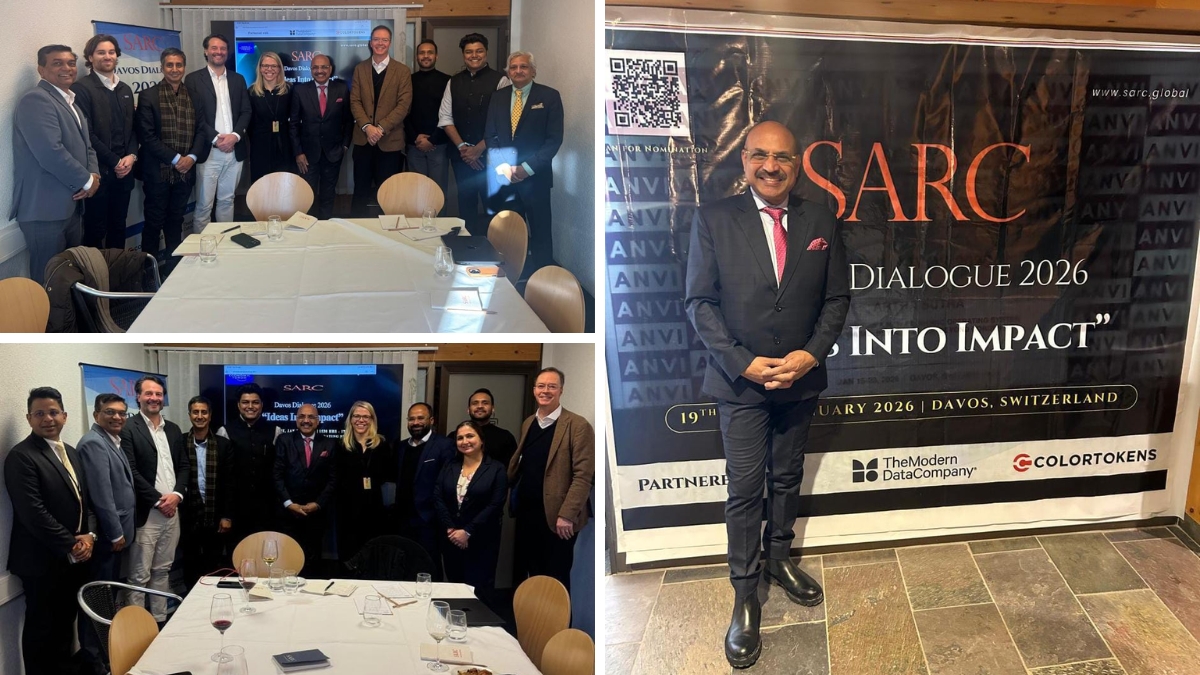
Against this backdrop, SARC advanced its closed-door deliberations at the SARC Davos Dialogue 2026 – Ideas to Impact with two strategically linked roundtables examining India’s evolving role in global trade and supply-chain reconfiguration. On 19 January 2026, Day 1 – Roundtable 2, titled “India as the Next Supply-Chain Operating System,” explored how resilience, climate alignment, and policy credibility are reshaping supply-chain architecture. This was followed on Wednesday, 21 January 2026, by Day 2 – Roundtable 3, “Competitive Federalism: Which Indian States Will Win the Next Decade?”, which assessed how sub-national execution, regulatory certainty, and infrastructure readiness will determine India’s ability to convert global trade re-routing into durable economic advantage.
Guided by a vision of resilient strategic credibility, both roundtables were chaired by Sunil Kumar Gupta, Chairman & Global Leader, SARC Global, and were moderated by Namrata Singh Abrol, Founder, The Humanists Collective (Tampa, Florida, US) and Ranu Gupta, Co Founder & CEO, SARC Global, respectively, enabling rigorous, closed-door deliberations among policymakers, industry leaders, and domain experts.
Day 1 | Roundtable 2: Strategic Autonomy vs Global Interdependence
The second roundtable of Day One examined whether strategic autonomy can be achieved without sacrificing efficiency, innovation, or openness, as climate risk and policy volatility become structural features of the global economy. Participants underscored that climate change has become a systemic supply-chain risk, reshaping industrial policy, trade competitiveness, and capital allocation through extreme weather disruptions, carbon regulation, and ESG-linked finance. A sector-specific lens reinforced that strategic autonomy must be calibrated rather than ideological, with energy, semiconductors, pharmaceuticals, food systems, defence, and digital infrastructure requiring higher resilience, while other sectors continue to benefit from global integration.
Day 2 | Roundtable 3: Trade, Sanctions, and the Shadow Economy
Opening Day Two, SARC convened a focused discussion on how trade controls, sanctions dynamics, and compliance architecture are reshaping global commerce. A significant focus was placed on the shadow economy, with thediscussion noting that excessive sanctions and over-compliance often push trade underground. In contrast, India’s approach emphasises formalisation rather than exclusion.
Participants also discussed India’s use of regulated alternative settlement mechanisms. The session concluded that India’s model—combining trade regulation, compliance capacity, and strategic restraint—has helped limit the expansion of shadow trade while enhancing export credibility, tax realisation, and manufacturing inflows.
The roundtables featured contributions from Rajendra S. Bagade, Senior Partner, SARC; Probir Roy, Global Lead – Fintech, Gaming & Frontier Technologies, SARC; Ashutosh Verma, Leader – Technology and AI; Ankit Anand, Founding Partner, Riceberg Ventures; Balbir Singh, Senior Advocate, Supreme Court of India; Alicia Castillo Holley, GP and Founder, Wealthing VC Fund; Raphael Roettgen, Founder, E2MC (Earth-to-Mars Capital); Yuri G. Rabinovich, Founder and Managing Partner, VNTR; Medha Jaishankar, President, Omnivations; Siddharth Jena, Founder & CEO, AkashaLabdhi; and Yair Cleper, Co-Founder and Active Chairman, Magma Devs, Shardul Dabir, Lead – Field Development & Ecosystem Partnerships at the Institute for Climate Innovation (ICI), Nachiketa Das, Clark Parsons, Berrina Scheibe, Bernard Zupanc, Ruby Greber, & more.
In his closing remarks, Sunil Kumar Gupta, Chairman & Global Leader, SARC Global, said:
“India’s journey toward a Viksit Bharat @2047 is being carried forward by execution at scale—where compliance strengthens confidence, openness expands opportunity, and growth is built on systems designed to perform under stress. As the global economy enters a new phase of recalibration, India is not only keeping pace with change; it is contributing meaningfully to the shape of what comes next.”
If you have any objection to this press release content, kindly contact [email protected] to notify us. We will respond and rectify the situation in the next 24 hours.

